No, a franchise is not a passive investment

Somewhere in the last few years, franchising picked up a reputation as a way to own a business you don't have to run.
I understand where it comes from and there is a real thing underneath it. But the version most people arrive with is wrong in a way that costs money, so it's worth taking apart carefully.

Where the idea comes from
Two true things get compressed into one false one.
The first true thing: some franchise models genuinely are designed for an owner who doesn't work in the business day to day. That's a real category and it's grown.
The second true thing: a franchise gives you a system, which means the business doesn't depend on you inventing how to do the work. That's the actual product you're buying and it is worth a lot.
Compress those and you get "so it runs itself." It doesn't. What you've bought is a proven set of instructions and a brand people recognize. Somebody still has to execute the instructions, hire the people, fix what breaks, and decide what to do the week something happens that isn't in the manual.
What semi-absentee actually means
The industry term is semi-absentee, and the honest translation is: you don't do the work, you manage the person who does.
That is a real and meaningful difference. It's the difference between cutting hair and running a salon, between driving the van and running the route. In a well-chosen model it can genuinely be a handful of hours a week rather than a full-time job, and it's how a lot of people keep a career while building something of their own.
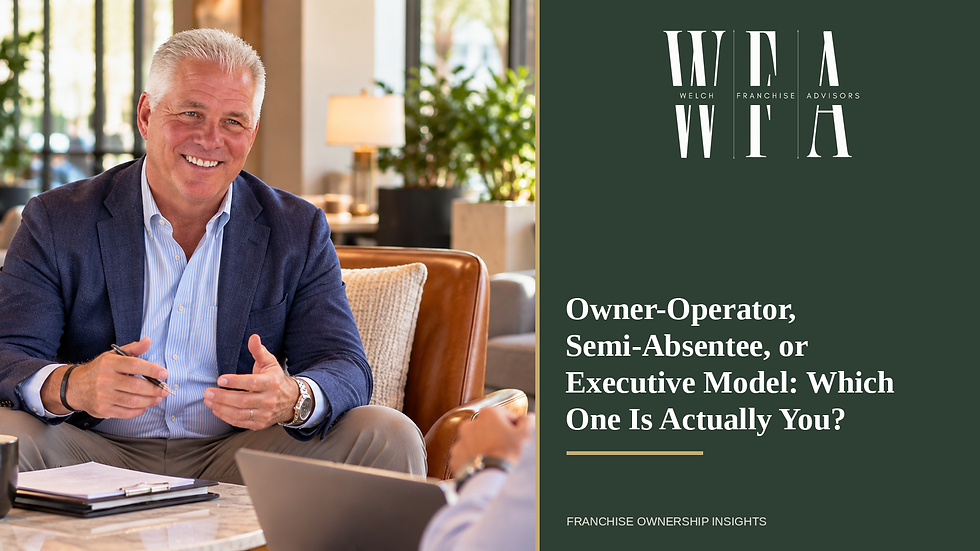
But look at what you've actually taken on. You are now responsible for hiring a manager good enough to run a business you aren't in, paying that manager, keeping them, and knowing enough about the operation to tell whether they're doing it well. That's a job. A smaller one, done at different hours, but a job. I compare the three ownership models side by side in Owner-operator, semi-absentee, or executive model: which one is actually you?
The manager is the whole model
If you take one thing from this: in a semi-absentee business, the manager is not a detail of the plan. The manager is the plan.
Every semi-absentee owner I've known who struggled had the same story, and it was never about the brand. It was that the first manager didn't work out, and the six weeks of finding a second one were spent by the owner personally, in the business, at the exact moment they had least capacity for it. The model didn't fail. The staffing did, and then the owner became the staffing.
So the questions to ask of any hands-off model are about people, not about the concept. What does this role pay in my market, and can I attract somebody good at that number? What's the turnover like across the system? Who covers if my manager quits in month four? Ask those on your validation calls and ask them of six owners, not one.
What "less hands-on" costs
Three things, and they're rarely counted up front.
A layer of payroll. The manager's compensation comes out of the business before anything reaches you. Two identical businesses, one owner-operated and one manager-run, are not the same business economically.
A slower ramp, usually. An owner in the building in year one tends to solve problems faster than a new manager does, because the owner cares more. That's not a criticism of managers; it's just what ownership does to attention.
Judgment you have to keep sharp from a distance. The hardest part of managing a manager is knowing what a normal week looks like well enough to notice an abnormal one. Most owners get that by working in the business first. If you never do, you're relying entirely on reporting, and reporting is a lagging indicator.
The hours nobody counts
Even at its most hands-off, there is a set of hours that stays yours and cannot be delegated.
The bank and the lease are in your name. The franchise agreement is your obligation. When somebody quits, when a piece of equipment dies on a Saturday, when a customer escalates past your manager, when the landlord wants to renegotiate, when the franchisor rolls out a change that costs money, that lands on you. Not every week. But on the weeks it happens, it is not a ten-hour week.
Plan for the average and you'll be fine most of the time and blindsided occasionally. Plan for the bad month and you'll be fine.
What actually is passive
Genuinely passive means you contribute capital and somebody else takes all operating responsibility, and the honest examples are things like index funds, bonds, or being a limited partner in something somebody else runs.
Those have their own risks and their own returns, and I'm not qualified to advise you on any of them; I'm not a financial advisor and this isn't financial advice. But if what you're actually looking for is an investment you don't think about, franchising is the wrong shelf, and I'd rather say that in the first ten minutes than an hour in.
How to test yourself
Three honest questions.
Would I be all right never being the best person in my own business at the actual work? Semi-absentee owners often aren't, by design. Some people find that freeing and some find it intolerable.
Am I good at hiring, and have I ever hired anyone? If the answer is no and no, an owner-operated model where you learn the work first might be the better first business, even though it asks more hours.
What happens to my week if the manager quits? If the honest answer is "I couldn't", the model doesn't fit your life yet, whatever the brand.
A question worth asking
Can a franchise be a passive investment?
Some franchises support semi-absentee ownership, but you still carry responsibility for hiring, the manager, finances, and performance. A model that uses a manager is not the same as an investment that requires no involvement.
What I'd do with you
Sort out early whether you want less time in a business or no time in a business, because those lead to completely different places. If it's less time, there are models genuinely built for it and it's worth being precise about which ones. If it's no time, I'll tell you that franchising isn't your answer, and you'll have spent an hour rather than a year finding out.
No cost for the conversation, no obligation, and I'd rather talk you out of the wrong shape of business than into it. Let's talk.


Comments